The CUSS Handbook / Kiosk accessibility requirements in the United States
Kiosk accessibility requirements in the United States
Conformance to an industry standard is not compliance with the law. In the United States, automated airport kiosks are governed by the Department of Transportation's rule under the Air Carrier Access Act, and it is prescriptive down to the level of tactile controls and speech output. This page summarises it. The regulation itself governs.
This is a summary, not legal advice. The authoritative text is 14 CFR Part 382 as published on the eCFR, and the requirements below are at § 382.57. Anyone making a compliance decision should read the regulation and take proper advice.
Where the rule came from
The kiosk requirements were created by a Department of Transportation final rule on the accessibility of web sites and automated kiosks at US airports, published on 12 November 2013 at 78 FR 67914. The rule document is worth reading alongside the codified text, because its preamble explains the reasoning behind choices the regulation states flatly.
Who and where it applies
The obligations fall on carriers, and they apply to any automated airport kiosk a carrier owns, leases or controls at a US airport with 10,000 or more enplanements per year.
A parallel set of obligations at § 382.57(b) applies to shared-use automated airport kiosks that carriers jointly own, lease or control. The definitional text at 14 CFR 382.3 describes a shared-use automated airport kiosk as a self-service transaction machine jointly owned, controlled or leased by an airport operator and carriers and/or an independent service provider, which provides carrier software applications enabling customers to independently access flight-related services. That is a common-use kiosk in the language of this site.
The 25 percent rule
Two related requirements set the level of provision, and both work per location.
- All automated airport kiosks installed on or after 12 December 2016 must be models meeting the design specification, until at least 25 percent of automated kiosks provided in each location at the airport meet it.
- At least 25 percent of automated kiosks in each location must meet the design specification by 12 December 2022.
“Each location” is defined as each cluster of kiosks and all stand-alone kiosks at the airport. This matters more than the headline percentage: an airport can be comfortably above 25 percent overall and still be non-compliant because one bank in one hall has none. The unit of compliance is the cluster.
The same 25 percent thresholds and the same two dates apply to shared-use kiosks under paragraph (b).
Function parity, priority and identification
Three further obligations shape how the accessible units must behave in service.
Function parity. Where kiosks in a location perform more than one function — the regulation gives printing boarding passes and bag tags, accepting payment for amenities such as seating upgrades, meals or Wi-Fi access, and rebooking tickets as examples — the accessible kiosks must provide all the same functions as the inaccessible ones. An accessible machine that can only print a boarding pass while the others can also rebook does not satisfy this.
Priority access. A passenger with a disability who requests an accessible kiosk must be given priority access to any available accessible kiosk in that location.
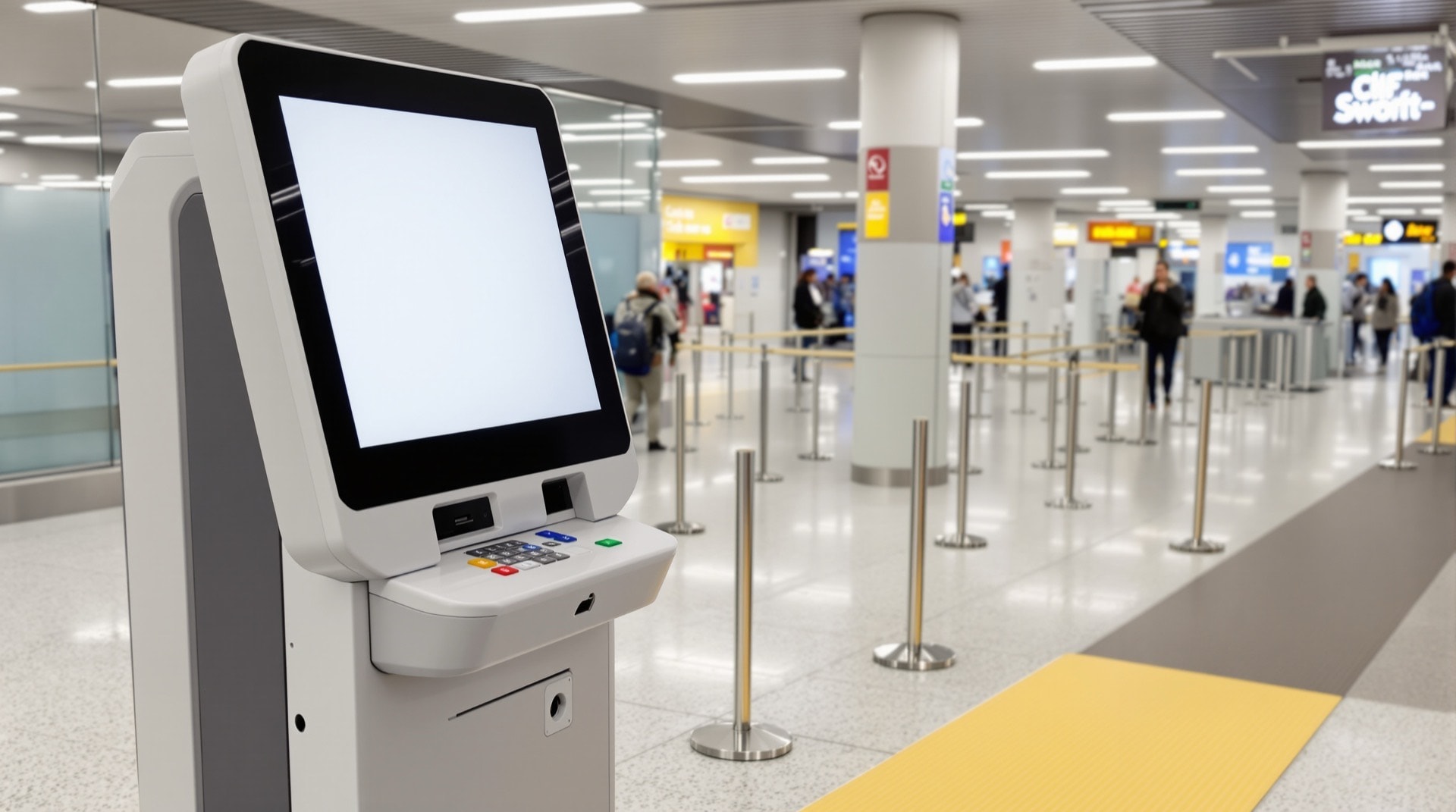
Identification and upkeep. Each accessible kiosk must be visually and tactilely identifiable to users as accessible — the regulation offers an international symbol of accessibility affixed to the front of the device as an example — and must be maintained in proper working condition. That second clause is an operational obligation, not a procurement one: an accessible kiosk that is out of service does not count.
Joint and several liability
For shared-use kiosks, a carrier is jointly and severally liable with airport operators and other participating carriers for ensuring compliance. This is the provision that most directly affects common-use programmes: neither the airport nor any individual airline can rely on another party having handled it, and the practical allocation therefore has to be written into the agreements between them. See who does what.
The technical design specification
Paragraph (c) sets out what a conforming kiosk must do, covering both physical design and the functions performed. In summary:
- Self contained. The kiosk must be operable without requiring the user to attach assistive technology, other than personal headsets and audio loops.
- Clear floor or ground space complying with section 305 of the Department of Justice's 2010 ADA Standards for Accessible Design.
- Operable parts complying with section 309 of the 2010 ADA Standards, plus four specific requirements: controls must be tactilely discernible without activation; where a timed response is required the user must be alerted visually and by touch or sound and given the opportunity to indicate that more time is needed; status indicators including locking and toggle controls must be discernible visually and by touch or sound; and colour coding must not be the only means of conveying information, indicating an action, prompting a response or distinguishing a visual element.
- Privacy. The kiosk must offer the same degree of privacy of input and output available to all users. If a screen-blanking option is provided in speech mode, the screen must blank when the user activates it — not automatically.
- Speech output. The kiosk must provide a speech output option. Operating instructions and orientation, visible transaction prompts, user input verification, error messages and all other visual information needed for full use must be accessible to and independently usable by people with vision impairments, delivered through a mechanism readily available to all users, such as an industry standard connector or a telephone handset.
Read those together and the design implication is clear: accessibility here is not a screen-contrast exercise. It reaches into the enclosure, the controls, the audio path and the application's own error handling — which means it reaches into the airline application, not only the platform.
Related standards worth knowing
Beyond Part 382, the US Access Board publishes the Revised 508 Standards and 255 Guidelines, covering information and communication technology including devices with closed functionality — the category a kiosk belongs to, since a user cannot install their own assistive software on it. Federal procurement and many state and institutional policies point at those standards, and the underlying web content guidelines are referenced widely for the interface layer. Requirements outside the United States differ and must be checked locally.
A note on scope
The definition of an automated airport kiosk turns on function and location rather than on what a supplier calls a machine. A self bag drop unit, a self-boarding gate or a rebooking terminal may fall within scope. Do not assume that a machine is outside the rule because it is not a check-in kiosk; establish it.