The CUSS Handbook / CUPPS: shared desks and gate podiums (RP 1797)
CUPPS: shared desks and gate podiums
CUSS covers the machine a passenger operates alone. CUPPS covers the position an agent operates on the passenger's behalf. They are siblings, they solve the same underlying problem, and almost every airport of consequence runs both.
What CUPPS is
Common Use Passenger Processing Systems is published by IATA as Recommended Practice 1797, jointly with Airports Council International, which publishes it as ACI RP 500A07. The joint publication is not a formality: check-in desks and gate podiums are airport infrastructure in a way kiosks are only partly, so the airport constituency has a direct stake in the specification.
The Recommended Practice and its technical specifications describe the range of services, specifications and standards that enable multiple airlines and service providers to share physical check-in or gate podium positions — either simultaneously or consecutively. The current version is 1.04, as listed by IATA.
Simultaneously or consecutively
That phrase carries more weight than it looks. Consecutive sharing is the familiar case: a desk is used by one carrier for a morning bank of departures and by another in the afternoon, with the agent logging into a different airline application in between. Simultaneous sharing is the harder one, where a single position handles more than one carrier at the same time — the normal situation for a ground handler working several airlines from one desk.
Supporting both is what makes CUPPS genuinely useful to an airport, and it is why the specification has to be careful about session isolation between carriers who may be direct competitors.
How it differs from CUSS
- The operator is staff, not a passenger. That changes almost everything about the interaction model. Agents are trained, repeat users working at speed, so the design pressure is throughput and keyboard efficiency rather than self-explanatory guidance.
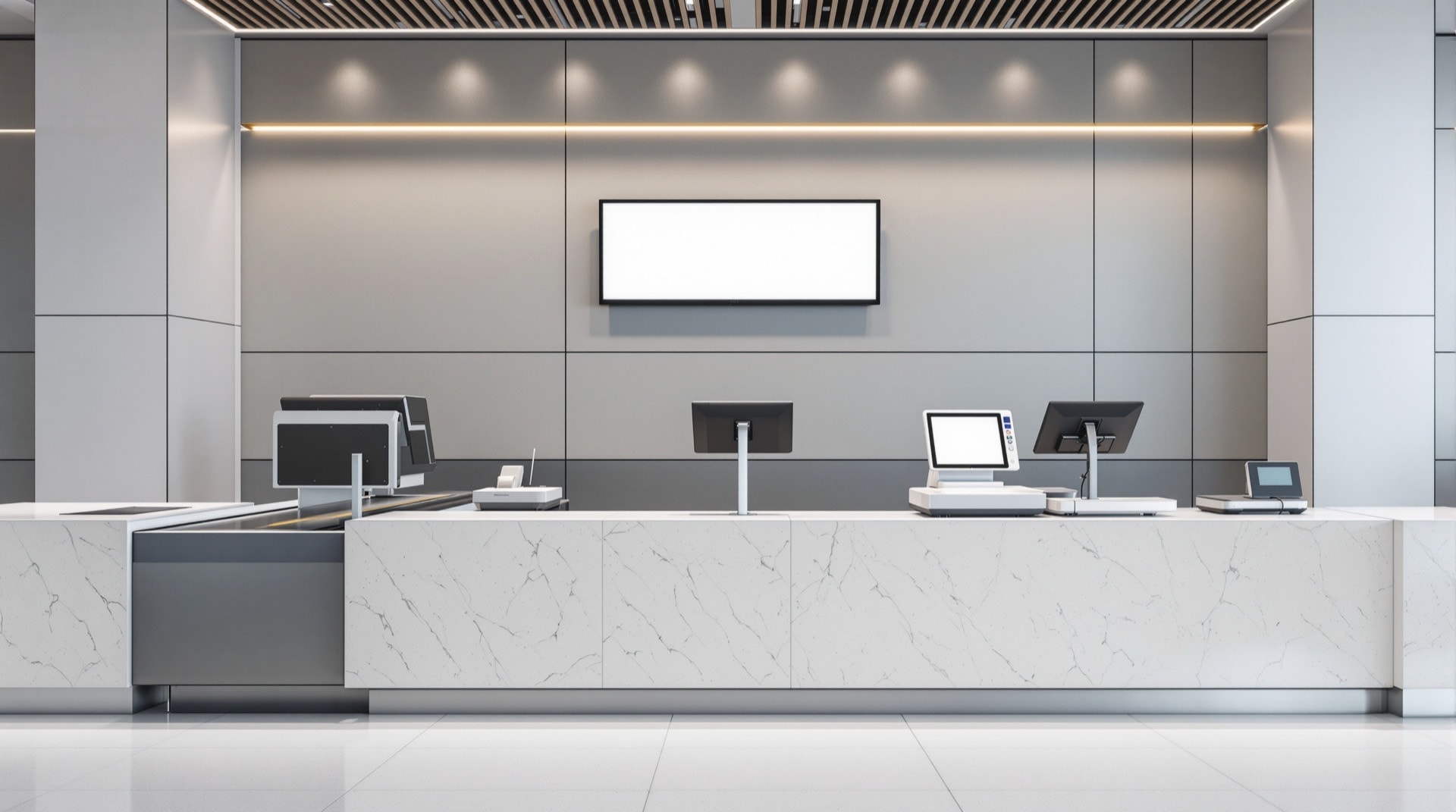
- The device set is different. A desk has an ATB or boarding-pass printer, a bag-tag printer, a boarding-card reader, a scale and often a conveyor interface. A podium has a gate reader and a display. Little of this appears at a kiosk.
- Authentication is a real concern. An agent signs in, and an airline needs to know which of its own staff or which handler's staff did what. A kiosk has an anonymous passenger.
- Legacy is heavier. Check-in desks predate self-service by decades, and CUPPS inherits from the earlier common-use terminal equipment generation. Terminal emulation and older presentation formats persist in the estate longer than anyone would like.
Where the two standards meet
Modern airports do not experience CUSS and CUPPS as separate programmes, and the specifications have converged in the places where that matters. IATA notes that recent CUPPS features include baggage drop device integration and self-boarding gates — both of which are functions a passenger may equally encounter unattended, and both of which are therefore also touched by the self-service side of the family.
There is a third specification worth knowing here. Common Use Web Services, IATA Recommended Practice 1741, standardises data exchange supporting common-use self-service bag drop through web-services technology, and covers tasks including passenger identification management, airside security access and boarding. It is the connective tissue for the functions that do not fit neatly into either the kiosk or the desk model, and it is increasingly where new common-use capability is specified.
Practical consequences for an airport
Running both standards means running two platform estates with overlapping but non-identical device fleets, two certification relationships and, frequently, two suppliers. A few things follow.
Do not procure them in isolation. The gains from common use come from flexibility across the whole passenger-processing estate, and a kiosk contract written without reference to the desk estate will produce two islands.
Expect the boundary to move. Bag drop is the clearest example: it began as a staffed desk function, became a self-service one, and is now specified in both directions. Anything written as though the boundary is fixed will age badly.
Watch the version pairs. The two standards move on independent timetables, and estate planning has to track both. IATA's common use standards page carries the current versions; the CUPPS technical specifications listing is the source for the CUPPS side.
For the self-service half of the picture, see the CUSS standard and common-use self bag drop.